|
Importance
of Treatment
Chronic liver disease is among the 10 leading causes of death
in the United States. Perhaps even more tragic, it claims the lives
of individuals in their most productive years. About half of the
deaths attributable to chronic liver disease occur before the age
of 60.
Persistence of the virus appears to be an important factor in disease
progression.
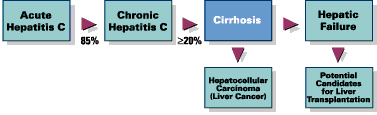
Progression of HCV Infection Can Lead to Serious Liver Damage
Rates of disease progression vary between chronic hepatitis
B and C patients, and by age. Only 5 to 10 percent of adults with
acute hepatitis B will progress to chronic disease. However, chronic
disease may develop in as many as 55 percent of children with acute
hepatitis B infections. In neonates, acute hepatitis B infection
leads to chronic disease in virtually all cases.
Acute hepatitis C will progress to chronic disease in up to 85 percent
of adult patients. Of this number, >20 percent will develop severe
chronic hepatitis resulting in cirrhosis, liver failure, and/or
hepatocellular carcinoma. Chronic hepatitis C leads to about 30
percent of liver transplants in the United States. Seventy percent
of all patients with liver cancers are hepatitis C positive.
Early Treatment Increases the Chances of Therapeutic Success
Evidence is compelling to indicate that patients who are
identified early in the course of their disease and treated when
virus levels are low, have the best results from treatment. In studies
with interferon, patients with less-severe histologic disease had
higher response rates to the therapy than patients with bridging
fibrosis or cirrhosis.
The goals of treatment for chronic viral hepatitis are to eradicate
the virus or decrease viral replication, decrease hepatic necrosis,
reduce symptoms of hepatic disease, and halt the progression to
cirrhosis and/or hepatocellular carcinoma. In chronic hepatitis
B, interferon alfa-2b therapy acts to stimulate the immune system
to fight the viral infections and can inhibit the viruses’ ability
to divide in liver cells. For previously untreated chronic hepatitis
C patients with compensated liver disease, and those who have relapsed
after alpha interferon treatment, another option is available:
combination therapy composed of ribavirin and interferon.
To review data on interferon alfa-2b, see the section, "INTRON
A Therapy." To review data on combination ribavirin plus
interferon alfa-2b, see the section, "REBETRON
Combination Therapy."
 |
3 of 11 |
 |
 

Terms and Conditions | Privacy Policy | Important Safety Information
|